


Oct 12, 2026
The bubble is the wrong thing to watch
Most talk about AI risk is about the bubble. Will spending on data centres collapse and take markets down with it, the way Lehman Brothers did in 2008? That risk is real, but it is a question about finance. AI may or may not produce a financial crash. Either way, a second question matters more over the next five years for companies and the people who work in them.
That question is substitution. Can an organization built around AI deliver the same outcome as a traditional one, at clearly better cost and at equal or better quality? Where the answer is yes, money, customers and work will move toward the new operating model. Where it is no, they will stay put.
The history of the motor car suggests the answer will arrive at very different speeds in different parts of the economy.
Same technology, different speeds
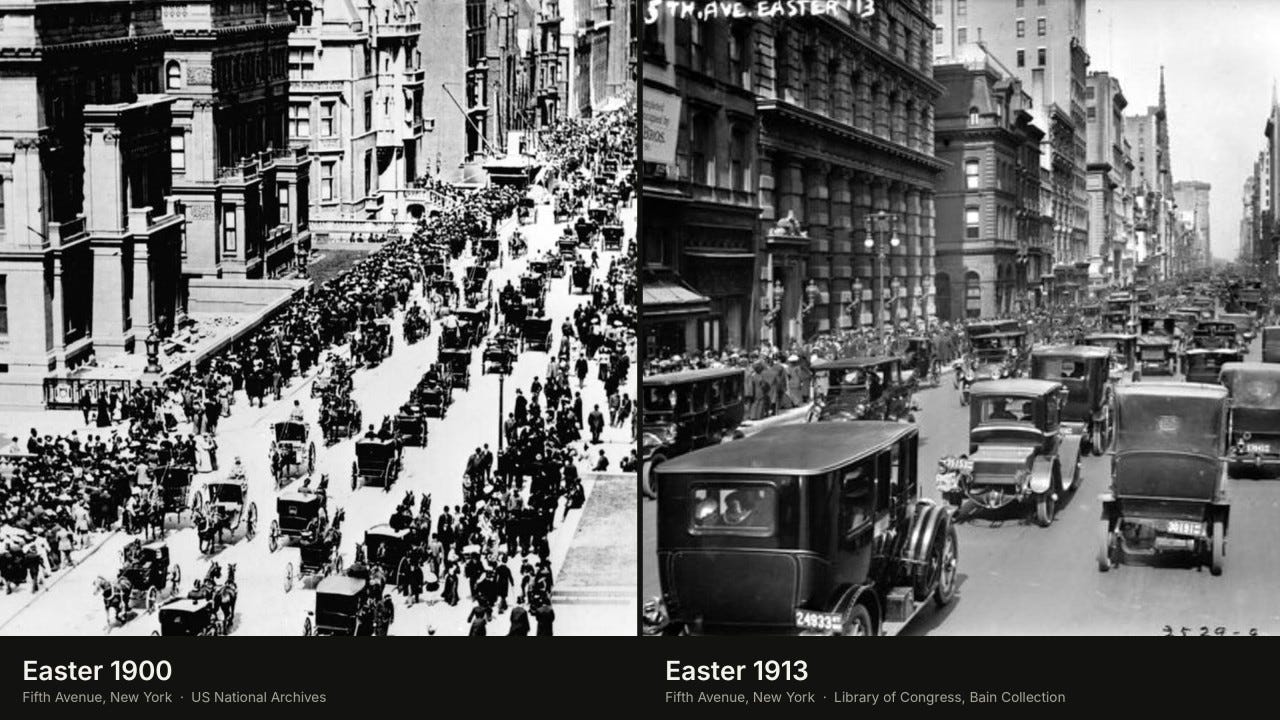
On Easter Sunday 1900, a photographer captured Fifth Avenue in New York full of horse-drawn carriages. The National Archives caption points out “only one auto” in the traffic. Photographs of the same avenue at Easter 1913, in the Library of Congress Bain Collection, show it crowded with motor cars. On the busiest city streets, the horse was gone in about 13 years.
Farms tell a different story. Horses and mules on US farms peaked at almost 26 million in 1920 and were still about 3.4 million in 1958. Economists who studied the tractor found that going from 10% to 90% of farms using one took at least 35 years.
It was the same underlying shift from animal power to machines, adopted at very different speeds. The horse-to-tractor transition suggests a useful way to think about AI. The same technology can bring fast substitution in one part of the economy and take decades to reshape another.
Four forces shape the speed
Capability alone did not decide how fast tractors spread. Research on the transition points to several forces that affected the pace. The four below are my synthesis of that research, and together they suggest four questions worth asking about AI.
1. The new tool can do enough of the job. Early tractors could do only part of a farm’s work. General-purpose tractors came in the 1920s and rubber tyres in the 1930s, and each step opened up more of it.
2. The economics favour the switch. While farm labour was cheap, horses still paid their way. Manuelli and Seshadri argue that only when wages rose after 1940 did keeping horses become the losing choice.
3. Friction and capital allow it. On cost savings alone, nearly twice as many Corn Belt farmers should have bought tractors in the 1920s as actually did. Sally Clarke’s study of the Corn Belt found that financial barriers held them back, even where the cost case already favoured tractors. Cities already had roads, fuel and garages.
4. A trigger makes staying put harder than changing. During the Depression, new federal farm credit rules helped push tractor ownership in the Corn Belt from 25% to 40% of farms.
The same four questions can be asked of any sector today. Can an AI-enabled organisation deliver the whole outcome? Are its economics or its service clearly better? What friction stands between a working example and wide adoption? And what could force the change?
Mapping sectors
Forces one to three combine into two questions that place a sector on a map.
The first is the strength of the substitution advantage. It covers capability and economics: how much of the outcome an AI-enabled organisation can deliver, and how much better its cost or service is. Sectors where most of the cost is people doing digital, rules-based work score high.
The second is the friction between proof and wide adoption. It is broad. It includes switching costs for customers, licences and regulation, liability when an automated decision goes wrong, trust, the capital needed to enter, access to data, the work of integrating with old systems, and plain organizational inertia.
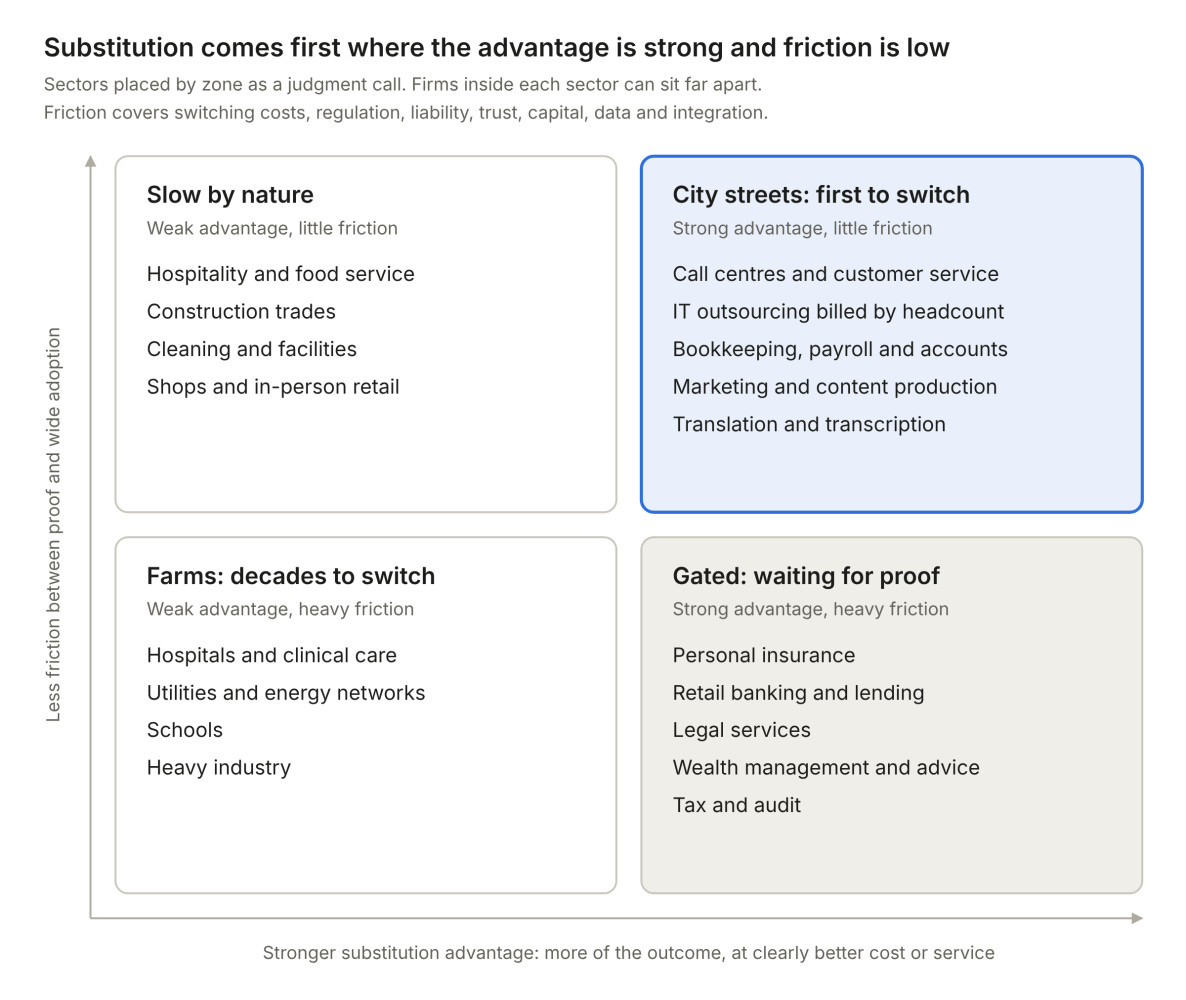
The placements are a judgment call, and they hide large differences inside each sector. In IT services, a firm that sells thousands of people doing repeatable work sits in the top right. A firm that modernizes complex legacy systems may gain from the change. The fourth force, the trigger, does not place a sector on the map. It decides when a sector moves.
The bet and the proof
Serious capital is betting that the advantage is real. Investors call the strategy an AI roll-up: buy established businesses with their customers and licences, then rebuild how the work is done around AI.
• Thrive Holdings, set up by Thrive Capital in 2025, was reported in March 2026 to be in talks to raise at least $2 billion, with about $1 billion already committed. Its holdings include Crete Professionals Alliance, which buys accounting firms, and Shield Technology Partners, which buys IT services firms.
• Jeff Bezos is in early talks to raise $100 billion for a vehicle that would buy manufacturers and automate their operations with AI, the Wall Street Journal reported in March 2026.
• American Growth Insurance launched in July 2026 with almost $70 million of committed equity to buy independent insurance agencies and brokers and rebuild them around AI. It had made one acquisition at launch.
• In June 2026 the Federal Reserve permitted Nir Zuk, founder of Palo Alto Networks, to buy voting shares in the parent of Liberty Bank, a $442 million California lender. Investors in the deal described it as a way to build an AI template for small US banks.
This money shows that investors believe the opportunity exists. It does not show that the model works, and none of these firms has yet published results that prove it.
The proof would be a firm operating the new model that shows clearly better economics together with equal or better customer outcomes. It could be a new entrant, an acquired business or an incumbent that rebuilt itself. Four quarters of that would be initial proof, and several years would be sustained proof. Lower costs alone would not count, because a firm can cut costs by giving worse service.
Lemonade, an insurer built around automation since 2016, is the closest early test with published numbers. In the second quarter of 2026 it says it spent 5% of premiums on handling claims, against an industry average of about 9%. Its trailing 12-month gross loss ratio fell from 70% to 59% in a year, and premiums in force grew 32% to $1.43 billion. It still lost $43 million in the quarter. Some operating advantages show in its numbers, but ten years in they have not produced an overall profit. Lemonade is also an earlier generation of automation than the agent-based models now being built.
If a convincing proof point does arrive, this is one plausible sequence:
1. Capital bets on the new operating model.
2. Operating proof arrives: one firm shows better economics and equal or better outcomes over time.
3. Customers move toward firms that offer the better service.
4. Incumbents come under pressure. Investors may reprice them, and they have to respond through investment, restructuring, acquisitions or lower prices.
5. The sector reorganizes around the new model, through new entrants or through incumbents that copy them.
Customer mobility is not negligible. UK current account switches rose 39% in the first half of 2026 compared with the same period in 2025.
The operating model is what gets substituted
Three different things can happen, and they are easy to blur together.
• Firm substitution. An AI-native challenger takes customers from an incumbent.
• Operating-model substitution. The incumbent survives but replaces labour-heavy processes with an AI-based model.
• Labour substitution. The same firm produces the same or more output with fewer people.
The job effects do not depend on the first. Even if every large incumbent survives, the second leads to the third. What gets replaced may be the operating model inside the company, while the company itself carries on.
Large incumbents are already moving in this direction. Bloomberg reported in March 2026 that HSBC is weighing up to 20,000 job cuts over three to five years, about one in ten of its 210,000 staff, mostly in non-client-facing roles. No final decision had been made, and HSBC declined to comment. On JPMorgan’s July 2026 earnings call, Jamie Dimon said there were discrete areas where the bank had reduced jobs by 30% or 40% as it deployed AI, and that most of those people were offered jobs elsewhere.
How the labour effect spreads
When core work needs fewer people, the effect moves in three directions.
Overhead that supports labour shrinks. Support work tends to scale with the number of people doing the core work. Fewer people in core roles means fewer needed in HR, recruitment, facilities, payroll and middle management.
Technology and control work may grow. An AI-based operating model needs people for AI governance, model testing, cyber security, data engineering, regulatory control and audit. Some of this work grows before the rest shrinks.
Labour-based suppliers are exposed. When cars replaced horses, blacksmiths, stables, feed merchants and carriage makers went with them. The closest modern equivalents are businesses whose revenue depends on manual work continuing: outsourced call centres, offshore back-office processors, and IT firms that bill by headcount for repeatable tasks. Firms that build AI systems, modernise old ones or run difficult critical systems may gain.
There are early signs, though the causes are mixed. India’s five largest IT services firms reported a net fall of about 7,000 staff in the year to March 2026, the first in two decades. Weak demand played a part, and TCS, which made the largest cuts, has said they reflect a skills mismatch more than AI. Concentrix, one of the largest call centre operators, expects revenue to fall 3% to 5% in constant currency in its fourth quarter. On its results call, management pointed to client programme cuts and faster AI automation.
Shocks make it sudden
Technology often improves gradually while job losses arrive in bursts. Economists Nir Jaimovich and Henry Siu found that 92% of the loss of middle-skill routine jobs in the US happened within a 12-month window around recessions. In earlier decades those jobs came back in the recovery. In the more recent recessions they did not. Their research establishes the timing pattern. It does not show the motives of individual firms. But it is consistent with a mechanism that matters for AI: downturns can concentrate changes that technology has already made possible.
The tractor story fits the same pattern. Adoption jumped when credit rules changed in the Depression, and again when wages rose after 1940.
This is where the comparison with 2008 may hold, though in a different way from the usual telling. AI does not need to cause a crash. My hypothesis, drawn from that evidence, has three stages:
1. Capability builds up quietly while the old way still pays.
2. A shock, such as a recession, a margin squeeze or a credit event, removes the resistance to change.
3. If the new model works, the change becomes hard to reverse. Output can recover without all of the displaced roles returning.
Any significant downturn in the next five years could be the accelerator, whatever its cause.
What could slow it or prove it wrong
This is a forecast, and several things could make it slower or wrong.
Quality. In February 2024 Klarna said its AI assistant was handling two-thirds of customer service chats, the work of 700 agents. In May 2025 its chief executive said the focus on cost had led to lower-quality service, and it started hiring people again. A cheaper model loses if the service gets worse.
Regulation. The EU AI Act treats AI used for credit scoring and for pricing life and health insurance as high-risk. The relevant high-risk obligations for these systems now apply from 2 December 2027, 16 months later than first planned. In the UK the FCA has said it does not plan to introduce extra regulations for AI and will rely on existing frameworks such as the Consumer Duty and the Senior Managers and Certification Regime. That leaves room to build, but existing accountability remains: relevant senior managers still have to answer for how AI systems are deployed and governed.
Liability. A US Senate investigation found that UnitedHealthcare’s denial rate for post-acute care rose from 8.7% in 2019 to 22.7% in 2022, a period when it used an algorithmic tool in managing these claims. UnitedHealth faces a class action over the tool and says doctors, not the tool, make coverage decisions. In March 2026 a court ordered it to hand over internal documents on how the tool was used. One case like this can slow a whole sector.
Trust. In a survey of more than 5,000 UK consumers for the FCA’s Mills Review, one in five said they would be likely to use AI that acts on its own within goals they set. The FCA reported that consumers are concerned about trust and control.
Incumbents adapt. If large banks, insurers and outsourcers adopt the new model fast enough, new entrants may never get their proof point. The change would then happen inside the incumbents, and the job effects described above would still follow.
How to tell if it is happening
No single data point will settle this. A low expense ratio at one AI-native insurer is an anecdote. The evidence is a set of linked indicators moving in the same direction, and the rate of change matters more than the level. A gap that widens each quarter means far more than a gap that stays the same.
Five signals follow the chain from proof to jobs.
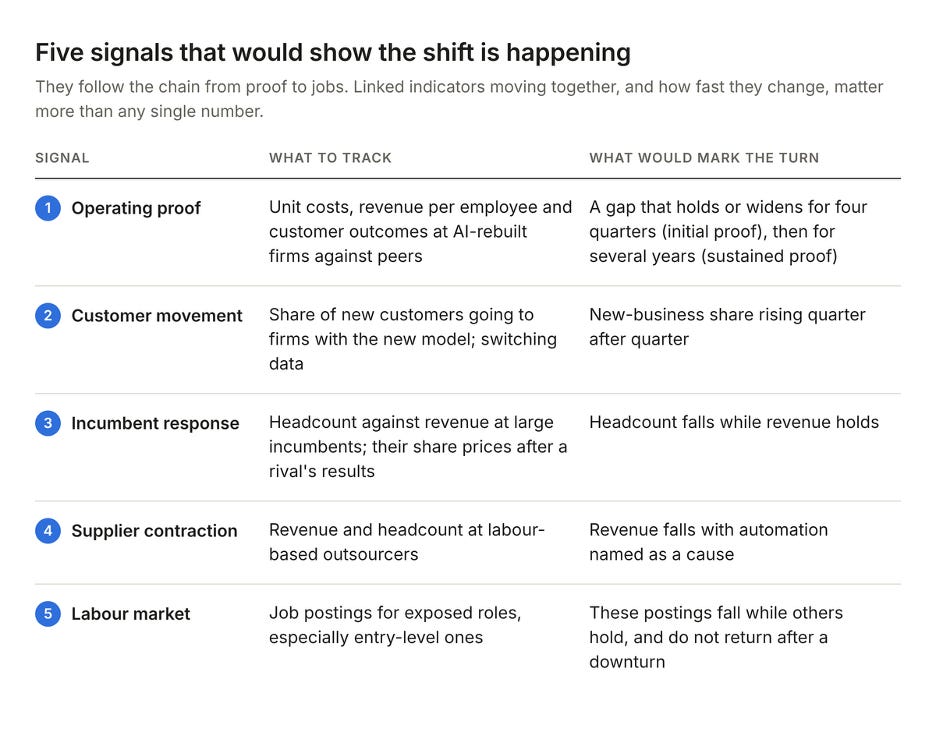
The Streets and Farms Watchlist has the full version. It scores any sector on the four forces, places it on the map, and lists eight signals with public data sources and ready-made Google Alerts.
In short
AI-based operating models will compete with labour-intensive ones. Sometimes a new company will carry the new model, and sometimes an incumbent will adopt it. Either way, once the new model proves clearly better, capital, jobs and suppliers start to reorganise around it. How fast that happens in a given sector depends on the size of the advantage, the friction in the way, and the timing of the next shock.
Sources
Archives, data, filings and research
• Fifth Avenue on Easter Sunday 1900, US National Archives (30-N-18827)
• 5th Ave., Easter 1913, Bain News Service, Library of Congress
• The use of horses and mules on farms, US Department of Agriculture
• Manuelli and Seshadri, Frictionless technology diffusion: the case of tractors (published version, American Economic Review)
• Clarke, New Deal regulation and the revolution in American farm productivity, Journal of Economic History
• Jaimovich and Siu, Job polarization and jobless recoveries, NBER
• Federal Reserve H.2 release, 27 June 2026: change in control of DMG Bancshares (Liberty Bank)
• Lemonade Q2 2026 shareholder letter, SEC filing
• Concentrix third quarter 2026 results, company release
• JPMorgan Chase Q2 2026 earnings call transcript, via The Motley Fool
• Klarna AI assistant handles two-thirds of customer service chats, Klarna
• Current Account Switch Service H1 2026, Pay.UK
• Regulation (EU) 2026/1744 amending the AI Act, Official Journal of the EU
• Review of the long-term impact of AI on retail financial services (Mills Review call for input), FCA
• FCA publishes review into the impact of AI on retail financial services (Mills Review), FCA
• Refusal of Recovery: Medicare Advantage post-acute care, US Senate Permanent Subcommittee on Investigations
Reporting and analysis
• Thrive Holdings in talks to raise at least $2 billion, Tech Funding News, citing Bloomberg
• Jeff Bezos aims to raise $100 billion to buy and revamp manufacturers with AI, Reuters, citing the Wall Street Journal
• AGI raises $70M to buy and transform insurance firms, SiliconANGLE
• Nir Zuk applies to acquire Liberty Bank parent, Banking Dive
• Lemonade Q2 2026 results, Insurance Journal
• HSBC mulls deep job cuts from multiyear AI-fuelled overhaul, Bloomberg
• Top IT firms’ headcount falls over 7,000 in FY26, IANS
• Skill mismatch, not AI: TCS CEO on layoffs, Outlook Business
• Concentrix Q3 2026 earnings call highlights, MarketBeat
• Klarna turns back to human customer service, Fortune
• Judge orders UnitedHealth to hand over documents in AI coverage case, Becker’s Hospital Review
• From horsepower to tractor power, Southeast AgNet