


In 1931 a 20-year-old British economics student named Ronald Coase won a travelling scholarship to the United States. He spent the year visiting factories and offices with one question in his head. If markets are so good at setting prices and moving resources around, why do companies exist at all? Why doesn’t every worker sell their time by the task to whoever pays the most?
His answer took six years to write down and won him a Nobel Prize sixty years later. Using the market costs money. You have to find the right person, agree a price, write a contract and check the work. Past a certain point it is cheaper to hire people and manage them than to buy their work one piece at a time. That trade-off sets the size of every company on earth.
Keep Coase in mind. We will come back to him.
The number everyone is reacting to
In the past 11 months Anthropic has signed about $517 billion of compute agreements. That is close to 15 gigawatts of capacity, some of it on contracts of up to 25 years. OpenAI passed its 10 gigawatt Stargate target and kept going. It took a 20-year lease on a site in Ohio that starts at 4.25 gigawatts and can grow to 8. Amazon, Alphabet, Microsoft and Meta together are on track to spend around $700 billion on capital projects this year.
Most commentary on these numbers asks one question. How can companies with tens of billions in revenue justify commitments in the hundreds of billions? People answer it by comparing the spending with the software industry. By that measure, the spending looks reckless.
I think that is the wrong ruler.
Measure it against wages
Workers take home roughly half of everything the world produces. By a rough estimate, that puts the global wage bill near $55 trillion a year. The labs are building to take on a share of that work. Measured this way, a year of Big Tech capital spending comes to a little over 1% of one year of global wages.
That changes the question. Nobody disputes that $700 billion is a lot of money. What matters is whether it buys a place in a market that large. The people signing 25-year leases have decided that it does.
Most work never needed the smartest people
Most work in most companies is repeatable: invoices, claims, onboarding, scheduling, reconciliations, customer queries. We never filled those jobs with our brightest people, because we didn’t need to. We needed people who were reliable and affordable, in large numbers.
AI is being organised the same way. Cheap, dependable models running in loops, thousands at a time, will do the high-volume work. A smaller number of frontier models will plan the work, check it and handle the hard cases. Engineers already build systems like this and call it model routing. Routine steps go to a small model and difficult steps go up to a large one. Teams that do this report cutting costs by around 60%.
The frontier models are the executives and the cheap models are the workforce. Both come from the same companies and run in the same data centres. Excitement about the frontier raises the money, and the money builds the capacity the whole workforce runs on. The labs are selling the future to pay for the present.
What the insiders can see
The people inside the labs are watching two curves that most commentators ignore.
The first is revenue. Anthropic ended 2025 at an annual run rate of about $9 billion. By July 2026 it was $65 billion, and investors expect $100 billion or more by the end of the year. No software company has grown at that speed before.
The second curve matters more. This month Anthropic reported that Claude now leads 26% of its measured research and development work, completing most tasks end to end while humans supervise. In February the figure was below 1%. In August about 30,000 AI agents were working at the same time on its internal platform.
Think about what that does to a race. When your product helps build the next version of your product, the company in front moves faster than the companies behind it, and the gap widens. Compute is the fuel for that loop, so you lock up the fuel early. That is why the leases run for decades. It is also why both labs were still hunting for extra data centre sites last week.
Dario Amodei explained the logic in an interview in February. “Each model makes money, but the company loses money,” he said. A model that cost $1 billion to train brought in $4 billion the following year. The company still shows a loss because it is paying for the next, much larger model. He was also plain about the risk: “If you’re off by only a year, you destroy yourselves.” The argument inside the industry is about timing. The direction has been settled for some time.
Back to Coase
Remember the young economist and his question. Companies exist because coordinating people through the market is expensive. So what happens when the cost of coordinating collapses?
If one model can do the thinking inside a business and another can direct it, much of what a company is becomes a set of instructions running on someone else’s model. The separate firm matters less. What remains are the things that cannot be copied. The first is physical: chips, power and buildings, which are scarce and slow to build. The second is the thinking layer, the model provider whose lead keeps growing. The third is government, which holds the law, legitimacy and the power to tax.
Follow that to its end and you get an economy with three main parts: government, the company that supplies the thinking, and the companies that build the hardware. Amodei has said he expects the industry to settle at “three, maybe four” players, much like cloud computing. He has also said he is uncomfortable with how quickly power is concentrating, “almost overnight, almost by accident,” in companies that “will power so much of the economy.” He runs one of those companies, and he can see where it is heading better than most.
Why China doesn’t slow them down
Chinese open models are good and very cheap. By one count they now carry close to half the traffic on open model platforms. Their revenue is a small fraction of what Anthropic and OpenAI earn, somewhere between 1% and 10% depending on who is counting. Businesses still send their most valuable work, and most of their money, to the American labs.
So the American labs keep building. Cheap Chinese models competing for routine work do not threaten the research loop. A rival that closed its own loop would, which is why the labs push so hard for chip export controls. Chips are the fuel.
Who is actually worried
On 13 September Amodei published an essay called We Must Pace the Frontier. He warned that AI capability could move faster than our ability to control it. Elon Musk replied, “Dario is right.” Sam Altman agreed and added that pacing “does not mean stopping.” Chip stocks fell almost 6% in a day. Within a week both labs were back in the news, looking for more data centre space.
People outside the industry mostly worry that AI will not pay back the money. The worry inside the labs is that it will work too well and too fast. The spending only makes sense under the second view, and the people doing the spending have the data.
This is why Amodei doesn’t blink. He can ask the industry to pace itself and sign for more capacity in the same month because he is not worried about the money. He is worried about what the money buys.
The risks
None of this is guaranteed. Much of the financing goes in a circle. Nvidia helps fund OpenAI, OpenAI buys capacity from Oracle, and Oracle buys chips from Nvidia. On 16 September the Federal Reserve raised rates for the first time since 2023, which makes borrowed money more expensive. A large share of lab revenue comes from a small group of very large customers.
These risks are real, and they would do damage if the curves flattened. They are risks of timing and financing. The direction still holds.
What to watch
Watch three things over the next two years. First, the share of lab research done by AI, and whether it passes half. Second, whether the labs start selling finished work instead of selling tokens. Third, whether revenue keeps growing faster than any software company in history.
If those hold, today’s spending will look like early investment. Coase showed that the cost of coordination decides the shape of the economy. Amodei is betting that he is about to change that cost, and he is not blinking.
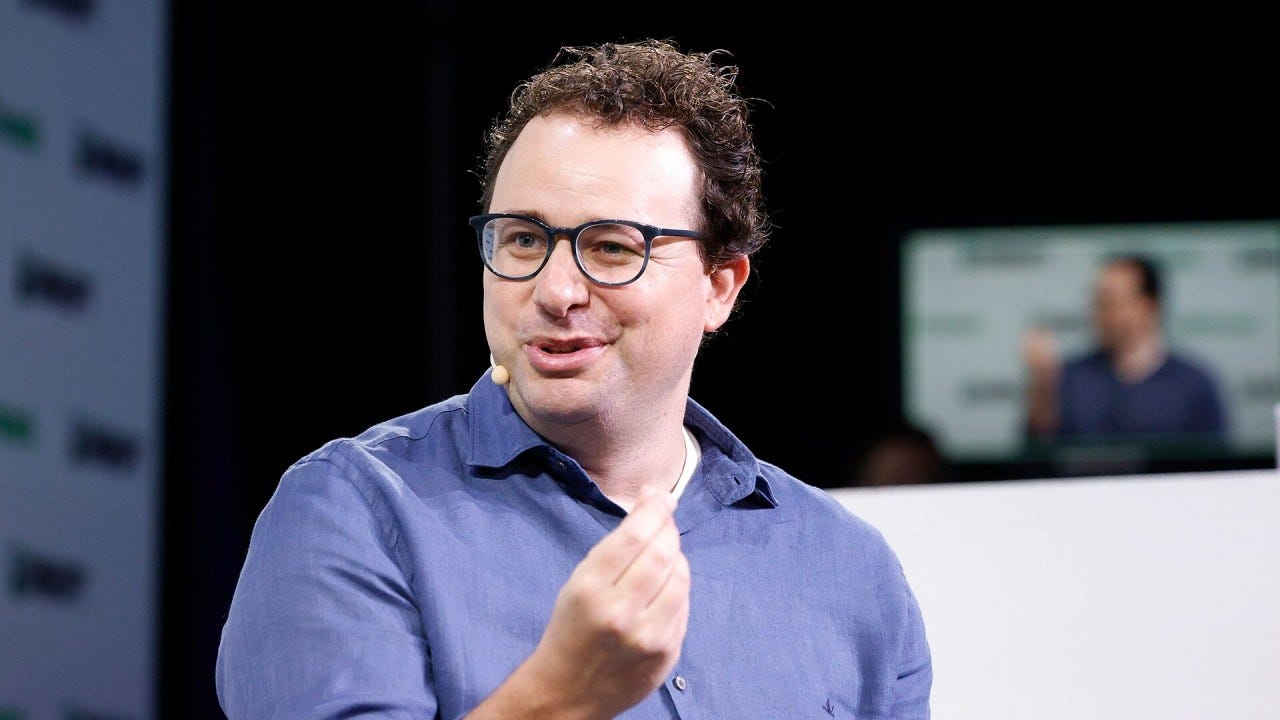
Photo: TechCrunch, CC BY 2.0, via Wikimedia Commons